
Why Manual Parking Management Is Costing Your Business More
Introduction
For many property owners and facility managers in Malaysia, manual parking management still feels like the simplest and cheapest way to run a car park. A boom gate, a few printed tickets, a guard on duty, and a cash drawer — it looks straightforward on paper. But behind this apparent simplicity lies a growing list of hidden costs that many businesses only notice once they add up their monthly expenses, disputes, and lost revenue.
As commercial buildings, shopping malls, hospitals, and residential complexes across Malaysia continue to grow busier, the limitations of manual parking systems become harder to ignore. What once seemed like a lower-cost solution can quietly turn into a source of inefficiency, revenue leakage, and customer dissatisfaction.
This article breaks down exactly why manual parking management often costs more than expected, the operational challenges it creates, and how modern parking technology — such as the systems developed by MaxPark — offers a more sustainable path forward.
What Is Manual Parking Management
Manual parking management refers to car park operations that rely heavily on human intervention rather than automated systems. This typically includes:
- Physical paper or printed tickets issued at entry
- Manual fee calculation and cash collection at exit
- Security guards or attendants managing barriers
- Handwritten or spreadsheet-based record keeping
- Manual monitoring of parking bay availability
In this setup, almost every step of the parking process — from vehicle entry to payment and exit — depends on a person carrying out the task correctly, consistently, and honestly, every single time.
Why Manual Systems Are Still Common
Despite the rise of automated parking technology, many Malaysian businesses still use manual systems, often because:
- The initial setup cost appears lower
- The property has operated this way for years without major complaints
- Decision-makers are unaware of the hidden long-term costs
- There is a perception that automation is only necessary for very large facilities
While these reasons are understandable, they often overlook the cumulative cost of inefficiency that builds up over time.
Hidden Costs of Manual Parking Management
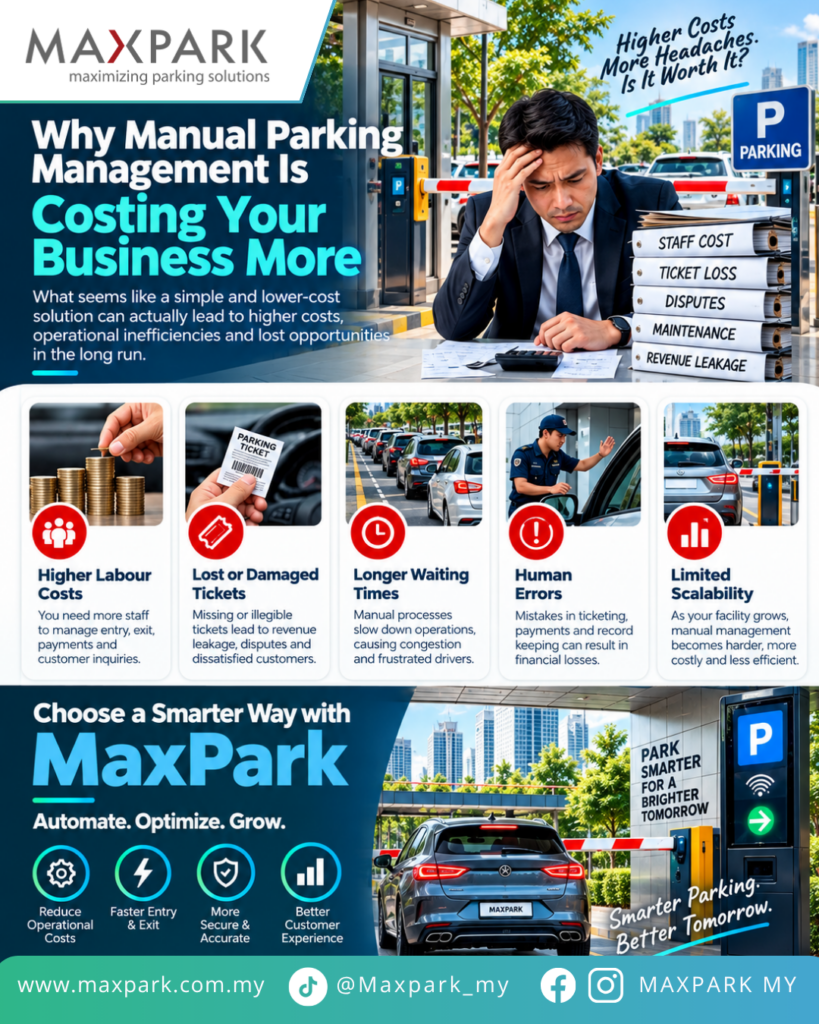
Higher Labour Costs
Manual parking operations are labour-intensive by nature. Staff are needed to manage entry and exit points, issue and collect tickets, calculate payments, and handle customer inquiries or complaints. As operating hours extend or traffic volume increases, more personnel are often required to maintain smooth operations.
Over time, staffing costs — including salaries, shift coverage, training, and supervision — can accumulate into a significant recurring expense, especially for facilities that operate extended hours or multiple entry points.
Lost or Damaged Tickets
Paper tickets are fragile and easy to misplace. A ticket that is lost, torn, or becomes illegible often leads to disputes at the exit gate, delays for other waiting vehicles, and in many cases, a loss of revenue when the correct parking duration cannot be verified.
These situations also create friction between staff and customers, which can affect the overall experience of visiting the property.
Longer Waiting Times
Manual verification and cash handling naturally take more time than automated processes. During peak hours, this can result in long queues at entry and exit points, causing congestion not just within the parking facility but sometimes spilling onto adjacent roads.
For businesses such as malls, hospitals, or commercial buildings, long waiting times can directly affect visitor satisfaction and, in retail settings, even discourage repeat visits.
Human Error
Because manual systems depend on people performing repetitive tasks accurately, errors are inevitable. Miscalculating parking fees, entering incorrect information, or issuing incorrect change are common mistakes that may seem minor individually but can result in noticeable financial losses when repeated daily across a busy facility.
Limited Scalability
As a property grows — whether through additional floors, more parking bays, or higher visitor volume — manual systems struggle to scale efficiently. Adding more entry points or extending operating hours usually means hiring more staff and creating more complex processes to manage, rather than simply expanding system capacity.
This makes manual parking management a less practical option for businesses that anticipate growth or seasonal spikes in traffic.
The Real Impact on Business Operations
Beyond the individual issues listed above, manual parking management can quietly affect a business in broader ways:
- Revenue leakage from ticket disputes, human error, or undetected fraud
- Operational inefficiency caused by slow processes and reliance on manual coordination
- Customer dissatisfaction due to long queues, delays, or unresolved disputes
- Difficulty tracking performance, since manual records make it harder to analyse occupancy trends, peak hours, or revenue patterns accurately
Individually, these issues may seem manageable. Collectively, they represent a significant and often underestimated cost of doing business.
Key Considerations Before Choosing a
parking Solution
Before deciding whether to continue with manual operations or move toward automation, businesses should consider:
- Current and projected traffic volume — Facilities expecting growth may benefit more from scalable systems.
- Operating hours — Extended hours increase the labour cost burden of manual systems.
- Customer experience priorities — Faster entry and exit can directly influence visitor satisfaction.
- Security and accuracy needs — Automated systems can reduce disputes and improve accountability.
- Long-term cost comparison — Rather than comparing only setup costs, businesses should evaluate ongoing operational expenses over time.
How MaxPark Addresses These Challenges
MaxPark’s parking solutions are designed to help businesses move away from the inefficiencies associated with manual operations. Rather than relying heavily on manual ticketing, cash handling, and staff-dependent processes, MaxPark focuses on automating and optimising key parts of the parking journey — from entry and exit to payment processing.
By reducing the dependency on manual intervention, MaxPark’s approach aims to:
- Reduce operational costs by minimising the need for extensive manual staffing at every entry and exit point
- Enable faster entry and exit through more streamlined vehicle processing
- Improve accuracy and security by reducing reliance on manual ticket handling and calculations
- Support better customer experience through smoother, less congested parking operations
Rather than positioning automation as simply “replacing staff,” MaxPark’s philosophy centres on helping businesses operate more efficiently, allowing personnel to focus on higher-value tasks such as customer service and facility oversight, rather than repetitive manual processes.
This aligns with MaxPark’s broader mission — as reflected in its tagline, “Automate. Optimize. Grow.” — of helping parking facilities transition toward smarter, more sustainable operations.
Practical Guidance for Businesses
Evaluating Their Parking Operations
If your business currently relies on manual parking management, here are some practical steps to assess whether a change is worthwhile:
- Track recurring pain points. Take note of how often disputes, lost tickets, or long queues occur, and estimate the time and cost involved in resolving them.
- Calculate true labour costs. Include not just salaries, but also training, supervision, and the cost of shift coverage during peak periods.
- Assess customer feedback. If visitors regularly mention long waiting times or parking-related frustration, this may be affecting your business reputation.
- Consider future growth. If your facility is expected to expand or attract more visitors, evaluate whether your current system can realistically scale.
- Compare long-term value, not just upfront cost. A system with a higher initial investment may offer significant savings and efficiency gains over time.
- Consult with parking solution providers. Speaking with experienced providers like MaxPark can help clarify which level of automation suits your specific facility size and operational needs.
Taking a structured approach to this evaluation ensures that any decision is based on actual operational data rather than assumptions.
Conclusion
Manual parking management may appear to be the simpler and more affordable choice at first glance, but the hidden costs — from higher labour expenses and human error to long waiting times and limited scalability — often outweigh the perceived savings. For businesses aiming to improve efficiency, protect revenue, and deliver a better experience for visitors, it is worth taking a closer look at how much manual processes are truly costing in the long run.
Choosing the right parking management approach is not just about adopting new technology for its own sake — it is about building a system that supports smoother operations today and sustainable growth tomorrow. This is the direction MaxPark aims to support, helping businesses move toward smarter, more efficient, and more scalable parking solutions.
As the saying goes on the sign at every MaxPark-equipped facility: smarter parking today paves the way for a better tomorrow.
Get an appointment
MAXPARK PARKING SOLUTIONS

Products
Solutions
Solutions
- Cashless Parking System - Touch 'N Go & PayWave
- Parking Guidance System (PGS)
- Vehicle Counting System (VCS)
- Discount Validator System