
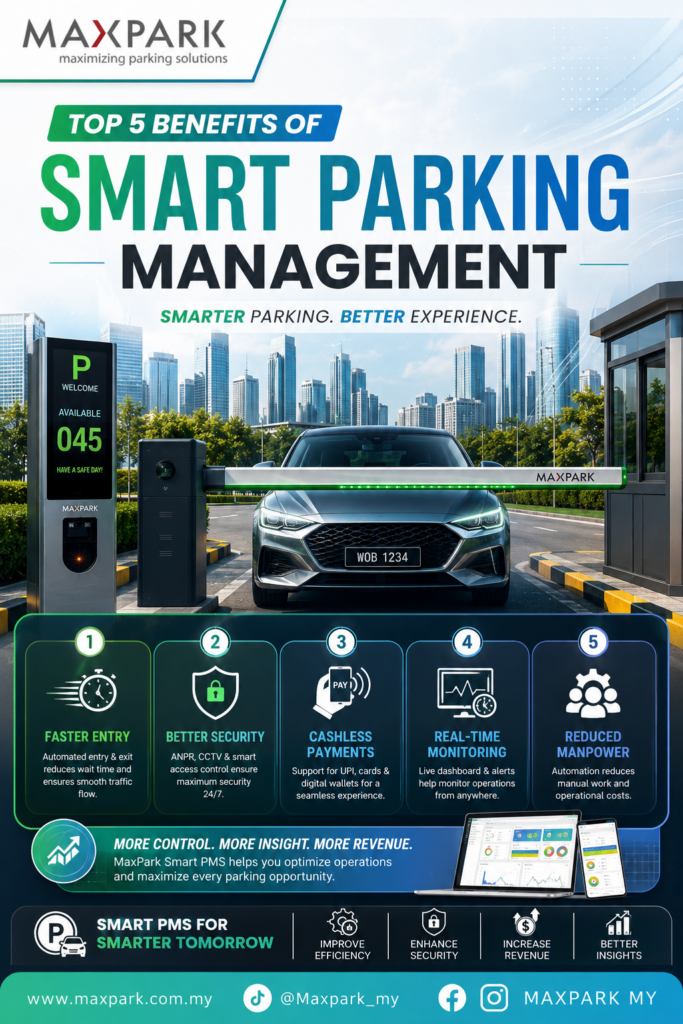
Top 5 Benefits of Smart Parking Management: Smarter Parking, Better Experience
Introduction
Parking is an essential part of modern transportation, yet managing a parking facility efficiently can be a complex challenge. As cities become more populated and vehicle numbers continue to grow, businesses, commercial buildings, offices, hospitals, shopping centres, and other facilities need parking systems that can handle increasing demand while providing a smooth experience for drivers.
Traditional parking management often depends on manual processes, physical tickets, cash payments, and on-site staff. While these methods can work, they may also lead to queues, slower entry and exit, higher operational costs, and limited visibility into what is happening inside a parking facility.
Smart parking management offers a more efficient approach.
By combining automation, access control, digital payments, monitoring systems, and real-time data, smart parking technology can transform the way parking facilities operate.
Here are the top five benefits of smart parking management and why they matter for modern businesses and property operators.
1. Faster Entry and Exit
One of the biggest advantages of smart parking management is the ability to make vehicle entry and exit faster and more efficient.
During peak periods, long queues at parking entrances and exits can quickly become frustrating for drivers. Delays can also create congestion around the surrounding roads and affect the overall flow of traffic.
Automated entry and exit systems can help reduce these delays by streamlining the access process.
Depending on the system implemented, technologies such as automated barriers, access control, vehicle recognition, and digital parking systems can help vehicles move through entry and exit points more efficiently.
Why faster access matters
A smoother entry and exit process can:
- Reduce waiting times
- Minimise vehicle queues
- Improve traffic flow
- Create a better experience for drivers
- Reduce pressure on parking staff
- Improve overall parking efficiency
For busy workplaces and commercial properties, even small improvements in vehicle flow can make a noticeable difference during peak hours.
The goal is simple: less waiting, smoother movement, and a better parking experience.
2. Better Security
Parking facilities need to do more than manage vehicles. They also need to protect people, vehicles, and property.
Smart parking management can integrate security technologies such as ANPR (Automatic Number Plate Recognition), CCTV surveillance, access control, and monitored entry and exit points.
These technologies can provide greater visibility over vehicles entering and leaving a facility while helping operators manage access more effectively.
How smart parking improves security
A connected parking system can help with:
- Vehicle identification
- Controlled access
- Entry and exit monitoring
- CCTV integration
- Suspicious activity monitoring
- Parking area surveillance
- Improved access records
Instead of relying entirely on manual observation, operators can have technology supporting the monitoring and management of the facility.
This is particularly valuable for locations where controlled access is important, such as offices, residential developments, private facilities, hospitals, and commercial properties.
Smarter access control means better visibility and stronger parking security.
3. Cashless Payments
The way people pay for products and services has changed dramatically. Consumers increasingly expect convenient digital payment options, and parking is no exception.
Smart parking systems can support cashless payment methods, allowing users to pay through digital channels rather than relying solely on cash.
Depending on the parking system, this may include options such as cards, mobile payments, or other digital payment methods.
Why cashless parking matters
Cashless payments can provide several advantages:
- Faster transactions
- Greater convenience
- Less dependence on cash
- Reduced manual payment handling
- Smoother customer experience
- More efficient parking operations
For parking operators, digital payments can also simplify transaction management and reduce some of the challenges associated with handling physical cash.
For drivers, the benefit is straightforward: park, pay, and move on with less hassle.
As digital payment adoption continues to grow, cashless parking is becoming an increasingly important feature of modern parking management.
4. Real-Time Monitoring
Effective parking management requires visibility.
Without accurate information, operators may find it difficult to understand what is happening across a parking facility at any given moment.
Smart parking systems can provide real-time monitoring and dashboards that allow operators to track parking activity, system performance, occupancy, alerts, and other operational information.
Instead of waiting for a problem to be reported manually, operators can have access to information that helps them respond more quickly.
What can real-time monitoring provide?
Depending on the system, parking operators may be able to monitor:
- Parking occupancy
- Vehicle movement
- Entry and exit activity
- System alerts
- Equipment status
- Payment activity
- Operational trends
This information can be particularly useful for facilities with large parking areas or multiple access points.
From reactive to proactive management
Traditional parking management can sometimes require staff to react after a problem occurs.
Smart monitoring can help operators identify issues earlier and make better-informed decisions.
With real-time information available, parking management becomes more proactive, efficient, and data-driven.
Better information leads to better decisions.
5. Reduced Manpower and Operational Costs
Managing a large parking facility can require significant manpower, particularly when many processes are handled manually.
Staff may be required to monitor entry and exit points, manage payments, assist customers, monitor parking areas, and perform other routine tasks.
Automation can reduce the amount of manual work required for many of these processes.
Smart parking management can automate areas such as:
- Vehicle entry
- Vehicle exit
- Access control
- Payment processing
- Parking monitoring
- Reporting
- Alerts and notifications
This does not necessarily mean eliminating people from the parking operation. Instead, automation allows staff to focus on tasks that require human attention while technology handles repetitive processes.
Lower manual workload, better efficiency
For property owners and parking operators, reducing repetitive manual processes can help improve operational efficiency and potentially reduce long-term operating costs.
Staff can spend more time handling customer service, maintenance, security, and other important responsibilities instead of performing routine parking tasks.
Automation helps businesses work smarter, not simply harder.
The Bigger Picture: Smarter Parking Management
The five benefits above are closely connected.
Faster entry and exit improves traffic flow.
Better security provides greater control and visibility.
Cashless payments create a more convenient customer experience.
Real-time monitoring gives operators better information.
Automation reduces repetitive work and improves operational efficiency.
Together, these features create a parking environment that is more connected, efficient, and user-friendly.
Smart parking is therefore more than simply installing an automated barrier or digital payment system. It is about creating an integrated parking management ecosystem where different technologies work together.
Why Businesses Should Consider Smart Parking
For businesses and property owners, parking is often one of the first experiences a customer or employee has when arriving at a facility.
A parking area with long queues, confusing access procedures, manual payments, and limited information can create frustration before a person even enters the building.
On the other hand, a well-managed smart parking facility can provide a smoother experience from the moment a vehicle arrives.
This can contribute to:
- Better customer satisfaction
- Improved workplace experience
- More efficient parking operations
- Stronger access control
- Better use of parking data
- Reduced operational workload
- More modern property management
As businesses continue to adopt digital technologies across their operations, parking should not be overlooked.
Smart Parking for Modern Workplaces
Workplaces are an excellent example of where smart parking can make a meaningful difference.
Employees often arrive within similar time periods, creating high demand for parking during peak hours. Visitors may also require controlled access to designated areas.
A smart parking system can help organisations manage these challenges while creating a more convenient experience for employees and visitors.
Automated access, real-time monitoring, cashless payments, and intelligent parking management can help turn parking from a daily inconvenience into a seamless part of the workplace experience.
Happy employees. Smart workplaces.
Preparing for the Future of Parking
Parking technology will continue to evolve as cities and businesses become increasingly connected.
Future parking systems are likely to become even more integrated with other smart city technologies, including digital mobility platforms, connected vehicles, mobile applications, data analytics, and intelligent transportation systems.
This means parking management will increasingly become part of a broader urban mobility ecosystem.
The facilities that adopt smarter solutions today can be better prepared for this increasingly connected future.
Conclusion
Smart parking management is transforming the way modern parking facilities operate.
From faster entry and better security to cashless payments, real-time monitoring, and reduced manpower, smart parking technology can deliver benefits for drivers, businesses, property owners, and parking operators.
The objective is not simply to automate parking. It is to create a faster, safer, more convenient, and more efficient parking experience.
As technology continues to shape modern cities and workplaces, smart parking will become an increasingly important part of efficient urban mobility.
Smarter parking means better management. Better management means a better experience.
And with the right technology, every entry can be controlled, every exit can be managed, and every parking space can be used more intelligently.
Get an appointment
MAXPARK PARKING SOLUTIONS

Products
Solutions
Solutions
- Cashless Parking System - Touch 'N Go & PayWave
- Parking Guidance System (PGS)
- Vehicle Counting System (VCS)
- Discount Validator System