
Smart Parking: Building a Smarter Future
Introduction
Finding a parking space should be simple, but in busy shopping malls, commercial buildings, hospitals, airports, and multi-storey car parks, it can quickly become a frustrating experience. Drivers may spend several minutes circling different floors and aisles before finding an available bay. This wastes time, increases unnecessary vehicle movement, and contributes to congestion within parking facilities.
This is where Smart Parking Guidance Systems are changing the way parking facilities operate.
By combining sensors, real-time data, digital signage, and intelligent software, smart parking systems can identify available spaces and guide drivers toward them. Instead of relying on guesswork, drivers receive clear information about where parking is available, creating a faster and more organized parking experience.
What Is a Smart Parking Guidance System?
A Smart Parking Guidance System is a technology-based solution designed to monitor parking availability and guide drivers to vacant spaces.
The system typically uses sensors, cameras, IoT technology, digital displays, LED indicators, and centralized software to collect and process parking information. The information is then displayed through signs or other interfaces, allowing drivers to make quicker decisions about where to park.
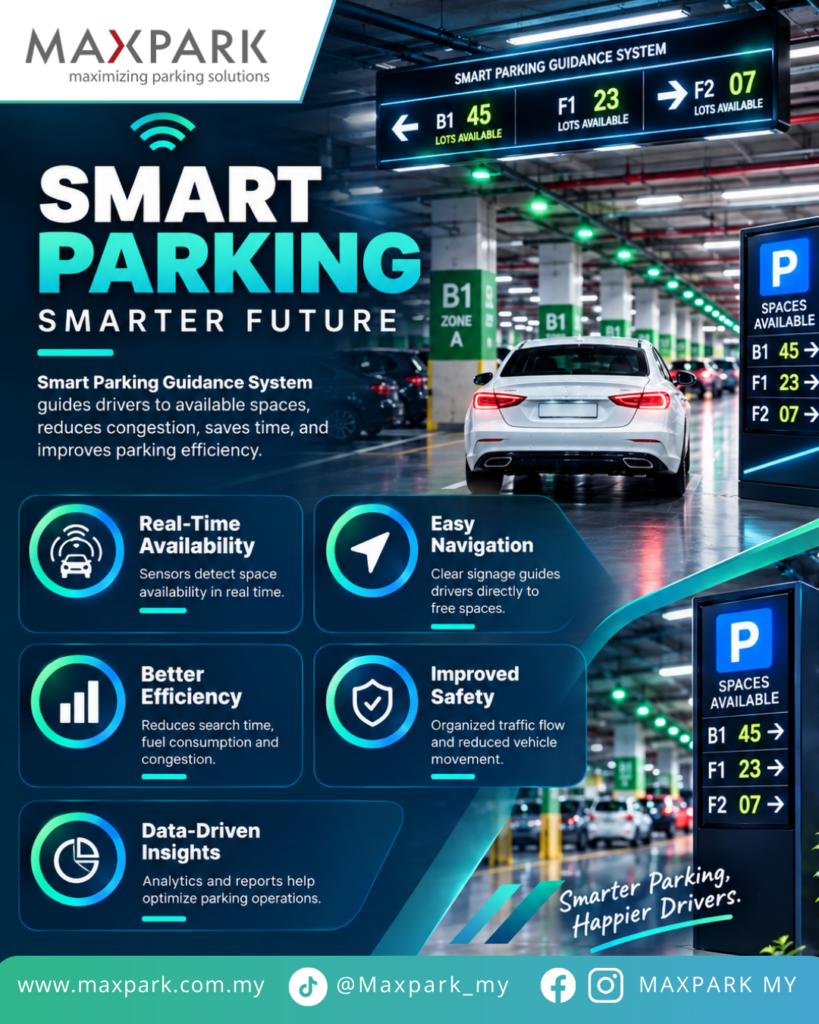
For example, instead of entering a multi-storey car park and searching every floor manually, a driver can immediately see information such as:
- B1 – 45 spaces available
- F1 – 23 spaces available
- F2 – 7 spaces available
The result is a more structured parking journey from the moment the driver enters the facility.
How Does Smart Parking Work?
A smart parking system works through several connected components.
1. Real-Time Parking Detection
Sensors or cameras monitor parking spaces and detect whether they are occupied or vacant. Depending on the system, technologies such as ultrasonic sensors, cameras, radar, magnetic sensors, or IoT devices can be used.
When a vehicle leaves a bay, the system can update its availability information, allowing other drivers to see that the space has become available.
2. Centralized Data Processing
The information collected from parking areas is sent to a central management platform. The software processes the data and provides operators with an overview of occupancy across different floors, zones, or sections.
This gives parking operators a clearer understanding of how their facility is being used.
3. Digital Guidance
The processed information is displayed through digital signboards, directional signs, LED indicators, or other guidance systems.
Drivers can then follow clear directions toward available areas instead of repeatedly driving around looking for a space. Parking guidance systems commonly combine occupancy information with dynamic signs and space-level indicators.
Key Benefits of Smart Parking
1. Real-Time Availability
One of the biggest advantages of smart parking is real-time visibility.
Drivers can see how many spaces are available in different areas of a facility without having to search blindly. This can make parking more predictable and reduce unnecessary circulation.
For parking operators, real-time occupancy information also provides valuable visibility into how different areas of the facility are being used.
2. Easier Navigation
Large parking facilities can be confusing, particularly for first-time visitors.
Clear digital signage can direct drivers toward available floors, zones, or parking areas. Instead of making repeated turns and searching through crowded aisles, drivers can follow a more direct route.
This creates a smoother experience and makes large car parks easier to navigate.
3. Better Parking Efficiency
Traditional parking can result in uneven use of available spaces. One section may appear crowded while another section still has plenty of vacant bays.
Smart parking helps distribute vehicles more efficiently by providing information about available spaces across the facility.
Better visibility can improve the effective use of existing parking capacity without necessarily requiring additional physical parking spaces.
4. Reduced Search Time and Congestion
Drivers searching for parking often circulate through the same areas multiple times. When many vehicles do this simultaneously, congestion can build up inside the car park.
By directing drivers toward available spaces, smart parking can reduce unnecessary vehicle movement and help create smoother internal traffic flow.
Research on smart parking has linked real-time availability information with reduced parking search activity and improved parking efficiency.
5. Improved Safety
Organized traffic movement is another important benefit.
When drivers spend less time searching randomly for spaces, there can be fewer unnecessary turns, sudden stops, and vehicle movements through busy parking areas.
Smart parking can also be integrated with technologies such as cameras, Automatic Number Plate Recognition (ANPR), and security monitoring, creating a broader parking management and security ecosystem.
Data-Driven Parking Management
Smart parking is not only about helping drivers find spaces. It also gives parking operators valuable data.
A centralized parking management platform can provide information about:
- Peak parking periods
- Occupancy levels
- Frequently used areas
- Underutilized zones
- Traffic patterns
- Parking demand
- Facility performance
This information can help operators make better decisions about parking operations, maintenance, staffing, traffic management, and future improvements.
Instead of managing a car park based mainly on observation, operators can use actual data to understand what is happening inside the facility.
Creating a Better Experience for Visitors
Parking is often the first and last interaction a visitor has with a commercial property.
A difficult parking experience can create frustration before a customer even reaches a shop, restaurant, office, or other destination. On the other hand, a smooth parking experience can make the entire visit feel more convenient.
For shopping malls, hotels, hospitals, offices, and other high-traffic facilities, smart parking can therefore become an important part of the overall customer experience.
A system that helps visitors find a space faster, navigate more easily, and leave the facility smoothly can contribute to a more positive impression of the property.
Smart Parking and Sustainability
Smart parking can also support more efficient and sustainable transportation.
Vehicles searching for parking may continue moving through a facility even when vacant spaces are available elsewhere. Reducing this unnecessary circulation can help reduce fuel consumption and vehicle emissions associated with parking searches.
Smart parking is therefore increasingly viewed as part of the wider development of intelligent and sustainable transportation systems.
The Future of Smart Parking
Smart parking technology is continuing to evolve.
Modern systems are increasingly incorporating IoT, artificial intelligence, advanced analytics, computer vision, cloud platforms, and predictive technologies. These technologies can help parking systems move beyond simply showing available spaces toward predicting demand and providing more intelligent operational insights.
Future parking facilities may become increasingly connected, with parking information integrated into mobile applications, navigation platforms, digital payment systems, vehicle systems, and broader smart-city infrastructure.
The goal is not simply to make parking more automated. It is to create a parking environment where drivers, operators, businesses, and the surrounding transport network all benefit from better information.
Why Businesses Should Consider Smart Parking
For property owners and parking operators, smart parking can provide benefits beyond convenience.
A well-managed system can help:
- Improve utilization of existing parking spaces
- Reduce unnecessary internal traffic
- Improve operational visibility
- Provide useful parking data
- Enhance visitor satisfaction
- Support security and monitoring
- Reduce manual monitoring requirements
- Create a more modern facility experience
For large commercial properties, these improvements can contribute to more efficient day-to-day parking operations.
Conclusion
Parking is becoming more than simply providing a place for vehicles to stop. As facilities become busier and customer expectations continue to increase, parking operators need better ways to manage space, traffic, and visitor experience.
A Smart Parking Guidance System brings these elements together through real-time detection, intelligent data management, and clear navigation.
For drivers, it means less searching, easier navigation, and a smoother parking experience. For operators, it means better visibility, improved efficiency, and data-driven management.
The future of parking is not about drivers searching harder for spaces. It is about technology helping them find the right space faster.
Smart parking isn’t just about finding a parking space — it’s about creating a smarter, more efficient, and more connected parking experience.
Get an appointment
MAXPARK PARKING SOLUTIONS

Products
Solutions
Solutions
- Cashless Parking System - Touch 'N Go & PayWave
- Parking Guidance System (PGS)
- Vehicle Counting System (VCS)
- Discount Validator System