
Smart Cities: Building the Future of Urban Mobility with Smarter Parking Solutions
Introduction
As cities around the world continue to grow, urban mobility is becoming an increasingly important challenge. More people, more vehicles, and greater demand for convenient transportation are putting pressure on existing road and parking infrastructure. Traffic congestion, fuel consumption, limited parking availability, and inefficient parking management can all affect the daily experience of commuters, businesses, and city residents.
This is where the concept of smart cities comes into play.
A smart city uses technology, data, and connected infrastructure to make urban environments more efficient, sustainable, and convenient. One important part of this transformation is smart parking. Modern parking guidance systems can help drivers find available parking spaces more quickly while giving businesses and property managers better control over parking operations.
With intelligent parking solutions, cities can move closer to a future where parking is not simply about finding an empty space, but about creating a smoother, more connected urban mobility experience.
What Is a Smart City?
A smart city is an urban environment that uses technology and data to improve how people live, work, travel, and interact with public infrastructure.
Smart city solutions can include:
- Intelligent transportation systems
- Smart traffic management
- Digital payment systems
- Connected buildings
- Energy-efficient infrastructure
- Real-time information systems
- Smart parking solutions
- Data-driven urban planning
The goal is not simply to introduce more technology. Instead, smart city technology should solve real-world problems and make cities more efficient, accessible, and sustainable.
Parking is one area where technology can make an immediate difference.
The Growing Need for Smart Parking
Finding a parking space can be frustrating, especially in busy commercial districts, shopping centres, office buildings, hospitals, airports, and other high-traffic locations.
Drivers may spend considerable time searching for an available space. During this process, vehicles can circulate around parking areas unnecessarily, contributing to congestion, fuel consumption, and emissions.
Traditional parking systems often provide limited information about space availability. Drivers may have to enter a car park and search manually before discovering that their preferred area is already full.
A parking guidance system changes this experience by providing drivers with information about available spaces and directing them towards suitable parking areas.
Instead of guessing, drivers can make informed decisions.
How Parking Guidance Systems Support Smart Cities
Parking guidance systems can become an important component of a connected urban mobility network.
By providing real-time parking information, these systems help connect the driver, parking facility, and wider transportation environment.
A typical smart parking solution can provide:
1. Real-Time Parking Information
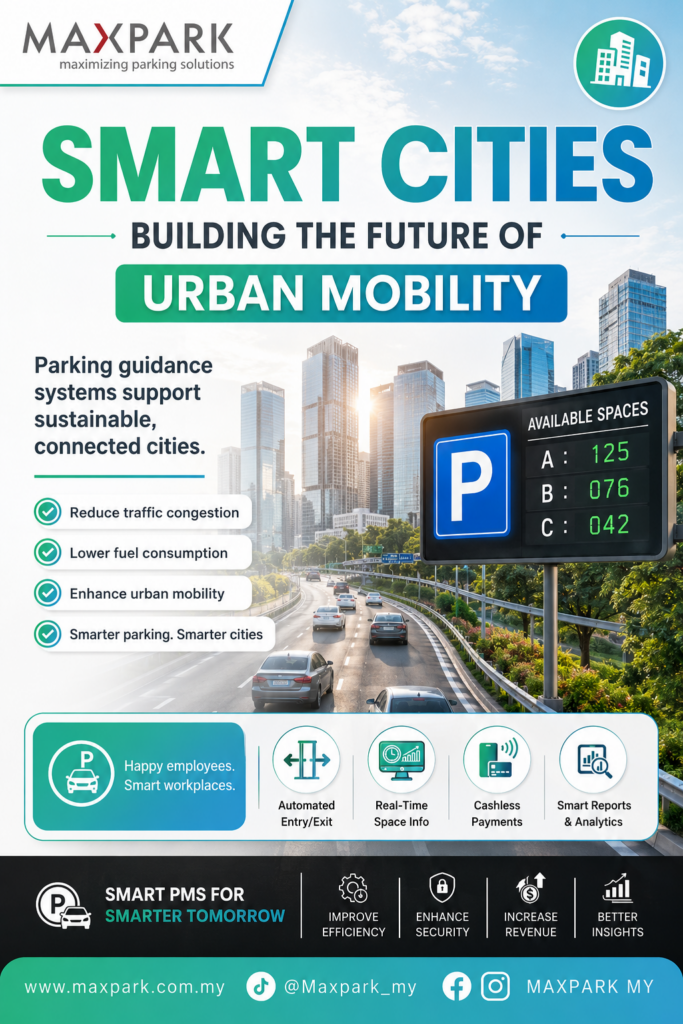
Digital displays can show drivers how many parking spaces are available in different zones or sections.
For example, a parking display may indicate the number of available spaces in Areas A, B, and C. Drivers can immediately see where parking is available without having to drive around searching.
This simple information can significantly improve the parking experience.
2. Reduced Traffic Congestion
Vehicles searching for parking can contribute to unnecessary traffic within and around busy areas.
By directing drivers towards available spaces, parking guidance systems can reduce unnecessary circulation and improve vehicle movement.
Less time spent searching for parking means smoother traffic flow and a more efficient journey.
3. Lower Fuel Consumption
Repeatedly driving around looking for parking can result in unnecessary fuel consumption.
When drivers are guided directly towards available spaces, they can spend less time searching and reduce unnecessary driving within parking facilities.
This can contribute to more efficient fuel usage and support broader sustainability goals.
4. Improved Urban Mobility
Parking is closely connected to transportation.
When parking facilities operate efficiently, the overall movement of vehicles through commercial and urban areas can also improve. Smart parking therefore supports a wider mobility ecosystem rather than functioning as an isolated service.
Creating Smarter Workplaces
Smart parking is particularly valuable in workplaces where employees and visitors arrive at similar times each day.
A well-managed parking facility can help employees spend less time searching for parking and more time getting to work.
Technology can also support features such as:
- Automated entry and exit
- Real-time parking information
- Cashless payments
- Parking occupancy monitoring
- Digital reporting and analytics
These features can create a more organised parking environment for both employees and facility operators.
The result is a better experience for users and more efficient management for businesses.
Automated Entry and Exit
Modern parking facilities can integrate automated entry and exit systems to streamline vehicle movement.
Instead of relying entirely on manual processes, automated systems can help manage vehicle access more efficiently.
This can reduce queues at entry and exit points while improving the overall flow of vehicles.
For busy commercial buildings and workplaces, efficient entry and exit management can make a significant difference during peak hours.
Cashless Parking Payments
Digital payment technology is becoming an increasingly important part of modern parking.
Cashless payment options can provide drivers with a faster and more convenient way to complete parking transactions.
They can also help parking operators reduce reliance on manual payment processes and create a more seamless customer experience.
As consumers become increasingly comfortable with digital payments, cashless parking is an important part of creating modern, connected parking facilities.
Smart Reports and Analytics
Smart parking is not only beneficial for drivers.
Parking operators and property managers can also use data and analytics to understand how their facilities are being used.
Parking data can help provide insights into:
- Peak parking periods
- Occupancy levels
- Space utilisation
- Vehicle activity
- Operational performance
- Parking demand
These insights can support better decision-making and help businesses optimise their parking facilities.
Instead of relying solely on assumptions, operators can use real-world data to understand parking behaviour and identify opportunities for improvement.
The Environmental Benefits of Smarter Parking
Sustainability is a major consideration in the development of modern cities.
Smart parking can contribute to environmental goals by helping reduce unnecessary vehicle movement.
When drivers spend less time searching for parking, there is potential for:
- Reduced unnecessary driving
- Lower fuel consumption
- Reduced traffic congestion
- More efficient use of existing parking infrastructure
Smart parking should therefore be viewed as part of a broader approach to creating more sustainable urban environments.
It is not a single solution to every environmental challenge, but it can play a valuable role in improving transportation efficiency.
Better Experiences for Drivers
Technology should ultimately make everyday experiences easier.
For drivers, smart parking can remove much of the uncertainty associated with finding a parking space.
Instead of entering a busy parking facility without knowing whether spaces are available, drivers can receive clear information and make faster decisions.
This can lead to a more convenient parking experience with less frustration and wasted time.
For employees, it can mean arriving at work more efficiently.
For shoppers, it can mean spending less time searching for parking.
For visitors, it can create a smoother first impression of a building or facility.
Benefits for Property Owners and Businesses
Smart parking can also provide important advantages for property owners and businesses.
A more organised parking system can improve operational efficiency while providing better visibility into how parking spaces are being used.
Businesses can potentially benefit from:
- Improved parking management
- Better utilisation of available spaces
- More efficient vehicle flow
- Real-time operational information
- Data-driven decision-making
- Improved customer experience
For large facilities, these improvements can contribute to better overall property management.
Building a Connected Urban Future
The future of urban mobility will increasingly depend on how different systems work together.
Parking should not be treated as an isolated part of transportation. It can connect with other smart city technologies to create a more integrated mobility ecosystem.
Imagine a future where a driver can receive information about available parking before arriving at a destination, navigate directly to an available area, enter automatically, pay digitally, and leave without unnecessary delays.
This is the direction in which smart mobility is moving.
Connected parking systems can become an important link between vehicles, buildings, digital services, and urban infrastructure.
Smart Parking and the Future of Malaysian Cities
As Malaysian cities continue to develop and urban populations grow, efficient mobility solutions will become increasingly important.
Busy commercial areas, office districts, shopping centres, residential developments, hospitals, and mixed-use developments all require effective parking management.
Smart parking technology can help these locations respond to increasing demand while improving convenience for drivers and efficiency for operators.
Solutions such as those provided by Maxpark are designed around the idea of making parking smarter, more connected, and more efficient.
By combining parking guidance, automation, digital payments, real-time information, and analytics, smart parking can support the development of more efficient workplaces and urban environments.
From Smart Parking to Smart Cities
The transition to a smart city does not happen through one technology or one infrastructure project.
It happens through the gradual integration of intelligent solutions into everyday urban life.
Smart parking is one practical example.
When a parking facility provides real-time space information, automated entry and exit, cashless payments, and useful analytics, it creates more than a convenient parking system. It contributes to a connected urban ecosystem.
The same principle can be applied across transportation, energy, buildings, security, and public services.
Every improvement contributes to a larger vision of a smarter city.
Conclusion
The future of urban mobility is about making cities more connected, efficient, and convenient for everyone.
Smart parking plays an important role in this transformation by helping drivers find available spaces, reducing unnecessary vehicle movement, improving parking management, and providing valuable data for businesses and property operators.
From real-time parking information and automated entry/exit to cashless payments and smart analytics, modern parking technology can create meaningful improvements in the way people interact with urban infrastructure.
Ultimately, smarter parking can contribute to smarter workplaces, better mobility, and more sustainable cities.
Smart parking. Smarter mobility. Smarter cities.
The future of urban mobility is already taking shape—and smarter parking is an important part of building it.
Get an appointment
MAXPARK PARKING SOLUTIONS

Products
Solutions
Solutions
- Cashless Parking System - Touch 'N Go & PayWave
- Parking Guidance System (PGS)
- Vehicle Counting System (VCS)
- Discount Validator System