
Parking Problems vs Smart Parking Solutions: How Technology Creates Smoother Operations and Higher Revenue
Introduction
Parking may look simple from the outside: vehicles enter, drivers park, and vehicles leave. But behind every successful car park is a complex operation involving access control, vehicle identification, payments, security, season passes, traffic flow, and daily monitoring.
When these processes are managed manually or through disconnected systems, problems can quickly appear.
Long queues can frustrate drivers. Manual entry can slow operations. Cash handling can create additional work. Unauthorised vehicles can gain access. Revenue can be difficult to track. And without real-time information, parking operators may not know what is happening inside their facility until a problem has already occurred.
This is where a Smart Parking Management System (PMS) can make a difference.
By combining technologies such as automated entry, ANPR, RFID, season-pass management, and centralised dashboards, smart parking systems can help property owners move from reactive parking management to a more controlled and data-driven operation. Research on smart parking systems similarly highlights the role of ANPR, sensors, and connected management platforms in reducing manual processes and improving operational visibility.
Traditional Parking Problems
Before looking at the solution, it is important to understand the problems that many parking facilities face.
1. Long Vehicle Queues
One of the most visible parking problems is congestion at entry and exit points.
During peak hours, vehicles can build up when drivers need to stop for tickets, interact with parking staff, scan cards, or complete manual procedures.
Long queues do not only waste time. They can also create congestion that extends beyond the car park and affects surrounding roads.
A parking facility should make vehicle movement easier, not become another source of traffic congestion.
2. Manual Entry
Manual parking operations often require staff to check vehicles, issue tickets, verify access, or handle other entry procedures.
While staff are important for customer service and operational support, relying heavily on manual processes can make parking slower and more difficult to scale.
Human involvement can also introduce inconsistencies and errors.
Smart parking systems can automate vehicle identification and access verification, allowing authorised vehicles to move through entry points more efficiently. ANPR-based systems, for example, can identify a vehicle’s number plate and record entry and exit information digitally.
3. Cash Handling
Cash payments can create additional responsibilities for parking operators.
Staff may need to collect, count, reconcile, secure, and report cash transactions. Manual payment processes can also make it harder to obtain immediate visibility into parking revenue.
Cashless parking provides an alternative by allowing transactions to be processed digitally.
Modern parking systems can integrate cashless payment methods with automated access and digital records, helping create a more seamless experience for both drivers and operators.
4. Revenue Leakage
Revenue leakage is one of the most serious concerns for parking operators.
Small gaps in the parking process can potentially result in lost revenue.
These may include:
- Unrecorded vehicle entries
- Incorrect transactions
- Unauthorised access
- Season-pass misuse
- Manual payment errors
- Incomplete records
- Poor reconciliation
- Limited operational visibility
The challenge is that revenue leakage may not always be immediately obvious.
Without accurate records and monitoring, it can be difficult for management to determine exactly where money is being lost.
5. Traffic Congestion
Parking and traffic management are closely connected.
When drivers have to wait at entry points, search for spaces, or queue to exit, the result can be unnecessary vehicle congestion.
Smart parking technology can help reduce this friction by automating access and providing better information.
The objective is to keep vehicles moving efficiently while giving operators greater control over the parking environment.
The Smart Parking Solution
Smart parking management takes a different approach.
Instead of relying on isolated manual processes, it connects parking hardware and software to create a more integrated operation.
A smart PMS can bring together:
- Automated entry and exit
- ANPR technology
- RFID access
- Season-pass management
- Digital payments
- Real-time monitoring
- Centralised dashboards
- Reporting and analytics
The result is a parking environment that is easier to monitor, manage, and optimise.
Automated Entry: Faster Vehicle Movement
One of the most immediate benefits of smart parking is automated entry.
When a vehicle approaches the entrance, the system can identify and verify it using technologies such as ANPR or RFID.
For authorised vehicles, the barrier can open automatically, reducing the need for manual intervention.
This can help:
- Reduce queues
- Improve traffic flow
- Reduce waiting times
- Minimise repetitive staff tasks
- Create a smoother arrival experience
ANPR-based systems can also record vehicle entry and exit times, providing useful digital records for parking management.
ANPR: Know Who Is Entering and Leaving
Automatic Number Plate Recognition (ANPR) is an important technology in modern parking management.
Instead of depending entirely on physical tickets or manual checks, ANPR cameras can capture a vehicle’s registration number and associate it with its parking activity.
This creates a digital record of vehicle movements.
For parking operators, this can provide greater visibility into:
- Vehicle entry
- Vehicle exit
- Parking duration
- Authorised vehicles
- Unauthorised vehicles
- Season-pass access
ANPR can also support ticketless parking environments, helping reduce the need for physical tickets and manual access procedures.
RFID: Convenient Access for Regular Users
RFID technology can provide another convenient method of vehicle identification and access control.
It can be particularly useful for regular users such as employees, residents, tenants, or registered season-pass holders.
Instead of manually checking every vehicle, an RFID-enabled system can identify an authorised credential and allow access according to predefined rules.
This can help make daily parking more convenient while giving operators greater control over access permissions.
Season Pass Management
Season parking can become difficult to manage when there are hundreds or thousands of regular users.
Manual records can make it challenging to keep track of active passes, vehicle details, access permissions, renewals, and changes.
A smart parking system can centralise season-pass information and connect access rights with the appropriate vehicle or user.
This can help operators manage regular parking users more efficiently while reducing opportunities for misuse.
Real-Time Dashboard: See What Is Happening
One of the biggest differences between traditional and smart parking management is visibility.
A centralised dashboard can provide operators with information about parking activity without requiring them to physically inspect every part of the facility.
Depending on the system, a dashboard can provide information such as:
- Vehicle entries
- Vehicle exits
- Occupancy
- Parking transactions
- Season-pass activity
- Access events
- System alerts
- Revenue information
Real-time monitoring and web-based management are increasingly used in smart parking systems to give administrators greater visibility and remote control over parking operations.
From Manual Management to Data-Driven Management
Traditional parking management often depends on experience and manual observation.
Smart parking adds another important element: data.
Once parking activity is digitally recorded, operators can analyse patterns and make better-informed decisions.
For example, management may be able to identify:
- Peak entry times
- Peak exit times
- Parking demand
- Vehicle activity
- Revenue trends
- Season-pass usage
- Operational problems
This information can help property owners understand how their parking facility is actually being used.
Instead of asking, “What do we think is happening?”, management can begin asking, “What does the data show?”
Improving Security
Parking is not only about convenience and revenue.
Security is equally important.
Smart parking systems can combine ANPR, RFID, CCTV, access control, and digital records to improve visibility over vehicle movements.
If an unauthorised vehicle attempts to enter, the system can help identify it and record the event.
For facilities such as offices, residential developments, hospitals, commercial buildings, and private properties, controlled access can provide an additional layer of security.
Modern parking access-control solutions commonly combine vehicle recognition with automated barriers and monitoring to ensure that authorised vehicles can enter more efficiently while improving access control.
Improving Efficiency
Automation does not simply make parking faster for drivers.
It can also make operations more efficient for property owners and parking managers.
When repetitive tasks are automated, staff can spend less time handling routine entry, access, and transaction processes.
This allows human resources to focus on areas where human involvement is more valuable, such as customer service, maintenance, security, and facility management.
The result can be a more streamlined operation with fewer manual touchpoints.
Increasing Revenue Protection
A smart parking system can also help property owners protect their parking revenue.
When vehicle movements and transactions are digitally recorded, operators have more information available for reconciliation and auditing.
This can help identify discrepancies and potential revenue leakage more effectively.
The goal is not simply to charge more.
It is to ensure that the revenue generated by the existing parking operation is accurately captured and managed.
Better records. Better control. Better revenue visibility.
Smarter Parking for Different Properties
Smart parking is not limited to one type of facility.
The technology can be adapted for different environments, including:
Commercial Buildings
Automated access can make parking more convenient for employees, tenants, and visitors.
Shopping Centres
Faster entry, efficient payment, and better traffic flow can improve the customer experience.
Residential Developments
ANPR and RFID can help manage resident and visitor access.
Hospitals
Controlled access and efficient vehicle movement are especially important in facilities where visitors and staff arrive throughout the day.
Offices
Season-pass and employee access management can simplify daily parking operations.
Mixed-Use Developments
A centralised system can help manage different user groups and parking requirements within the same property.
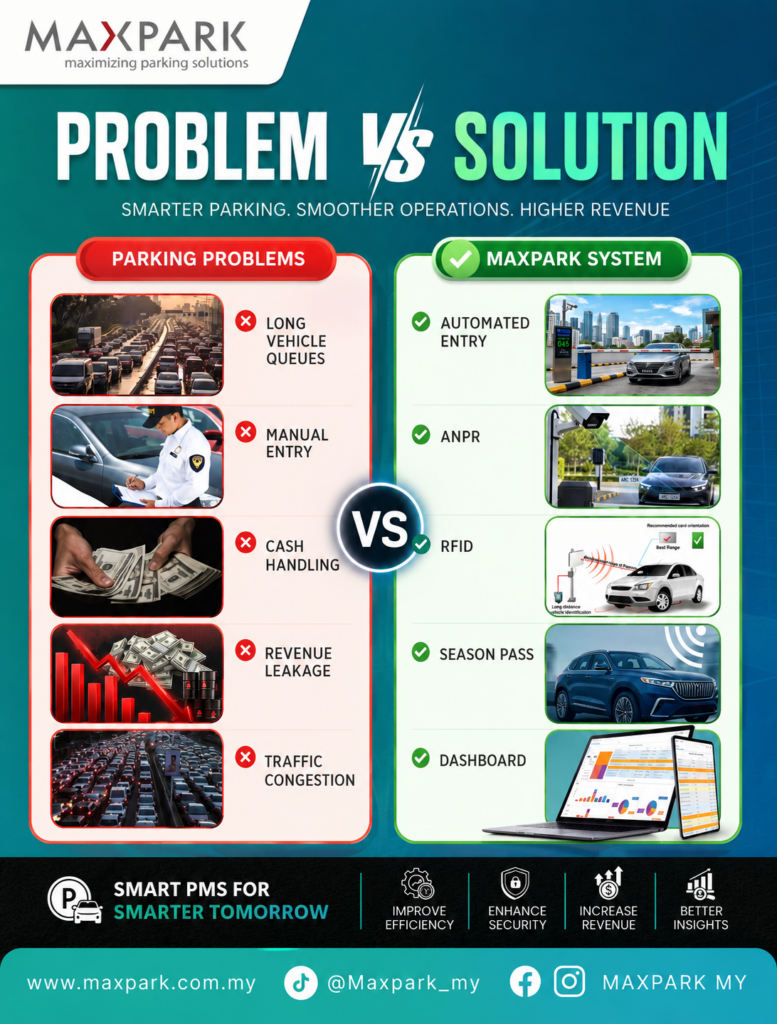
Problem vs Solution
The difference becomes clear when the two approaches are compared.
Long vehicle queues can be addressed with automated entry and exit.
Manual entry can be streamlined with ANPR and RFID.
Cash handling can be reduced through cashless payment options.
Revenue leakage can be addressed with accurate digital records and reporting.
Traffic congestion can be reduced through faster vehicle processing and better parking management.
The objective is not to replace every human process.
It is to use technology where technology can make parking operations more efficient, measurable, and reliable.
Why Smart Parking Is the Future
As buildings become smarter and businesses become increasingly data-driven, parking should evolve alongside them.
A parking facility is part of the overall customer and employee experience.
When parking is slow, confusing, or inefficient, it can negatively affect the perception of the entire property.
When parking is automated, secure, and easy to navigate, it becomes an invisible part of a smooth experience.
That is the real value of smart parking.
The technology works in the background so people can focus on where they are actually going.
Maxpark Smart PMS
A modern Parking Management System should bring together the essential components required to manage a parking facility effectively.
With solutions centred around automated entry, ANPR, RFID, season-pass management, and dashboard-based monitoring, Maxpark Smart PMS is positioned around the goal of making parking operations more efficient and measurable.
The focus is simple:
Improve efficiency.
Enhance security.
Increase revenue protection.
Deliver better insights.
When these elements work together, parking becomes more than a place where vehicles are stored. It becomes a managed, connected, and intelligent part of the property.
Conclusion
Traditional parking problems such as long queues, manual entry, cash handling, revenue leakage, and traffic congestion can create unnecessary costs for both businesses and drivers.
Smart parking offers a more connected approach.
With automated entry, ANPR, RFID, season-pass management, and real-time dashboards, parking operators can gain greater control over vehicle access, improve operational efficiency, strengthen security, and make decisions based on accurate information.
The future of parking is not simply about installing more equipment.
It is about connecting the right technology to create a better system.
Smarter parking. Smoother operations. Higher revenue.
With the right Parking Management System, the difference between a parking problem and a parking solution can be the technology working behind the scenes.
Get an appointment
MAXPARK PARKING SOLUTIONS

Products
Solutions
Solutions
- Cashless Parking System - Touch 'N Go & PayWave
- Parking Guidance System (PGS)
- Vehicle Counting System (VCS)
- Discount Validator System