
Why Every Commercial Space Needs a Smart Parking System in 2026
Introduction
Parking is one of the most overlooked “operations levers” in commercial properties. When parking is unmanaged, it quietly creates daily friction: drivers circle longer, congestion builds at entry/exit points, complaints rise, and staff spend time handling issues that shouldn’t exist in the first place. For property managers, owners, and commercial space operators, these problems translate into measurable operational costs—and missed revenue opportunities.
A smart parking system changes that equation. By combining real-time occupancy monitoring, parking guidance, and actionable reporting, MaxPark helps facilities run smoother, safer, and more efficiently. Below are the core operational outcomes you can expect when smart parking is implemented correctly.
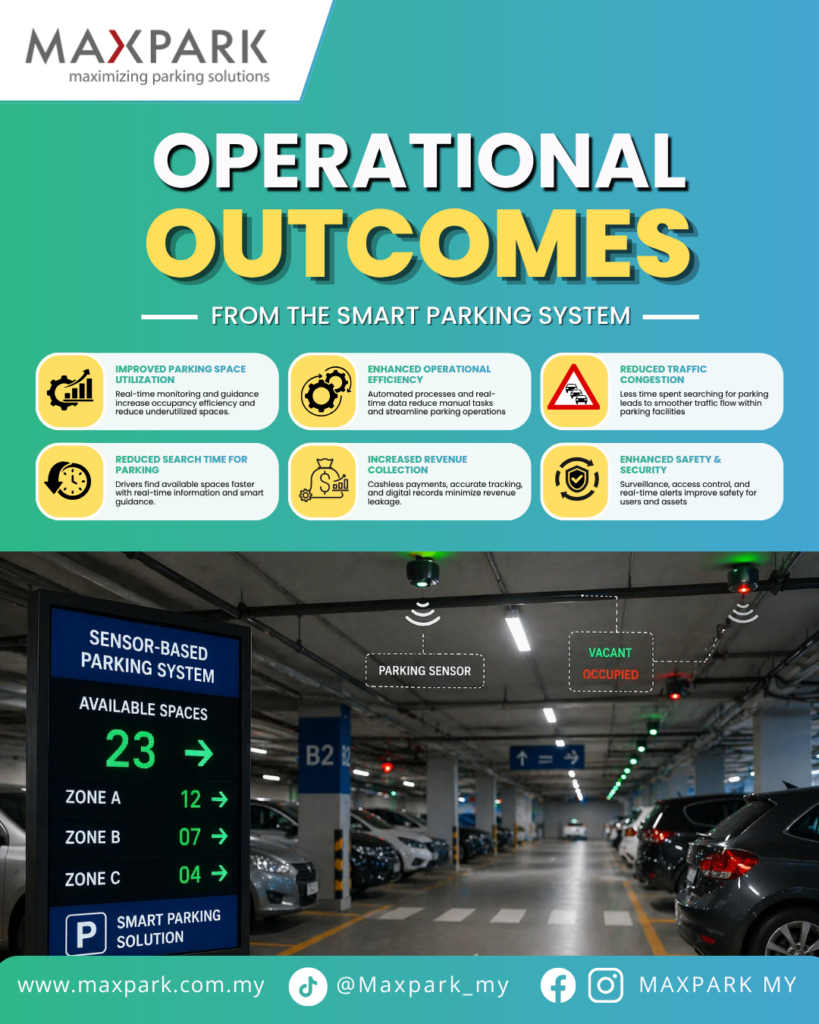
1) Improved parking space utilization
Many sites have enough bays on paper, but poor visibility and uneven distribution make the facility feel “full” even when it isn’t.
With a smart parking system:
- Real-time occupancy data shows which zones are underutilized.
- Drivers are guided to available bays faster, reducing clustering in popular areas.
- Operators can identify peak patterns and rebalance usage (e.g., reserved bays, staff zones, loading areas).
Operational impact: higher effective capacity without expanding the car park footprint.
2) Enhanced operational efficiency
Manual parking operations often rely on staff observation, ad-hoc enforcement, and reactive troubleshooting. Smart parking introduces automation and clarity.
Key efficiency gains include:
- Automated monitoring reduces the need for constant manual checks.
- Faster issue detection (e.g., unusual congestion, zone bottlenecks).
- Better coordination for security and maintenance teams through clearer visibility of traffic flow.
Operational impact: fewer manual tasks, faster response times, and more consistent day-to-day operations.
3) Reduced traffic congestion within the facility
Internal congestion is not just an inconvenience—it’s an operational risk. It can slow down tenant access, create safety hazards, and cause spillover onto surrounding roads.
Smart parking reduces congestion by:
- Shortening “search time” (less circling, fewer U-turns, fewer bottlenecks).
- Directing vehicles to the nearest available bays.
- Improving flow in high-traffic periods (weekends, events, peak office hours).
Operational impact: smoother circulation, better tenant/visitor experience, and fewer complaints.
4) Reduced search time for parking
Search time is one of the biggest drivers of dissatisfaction in commercial properties. It also increases fuel use and emissions—an increasingly important factor for ESG-minded property groups.
With MaxPark-style guidance and real-time availability:
- Drivers find bays faster with clear direction.
- Confusion is reduced for first-time visitors.
- Peak-hour stress decreases, improving overall site perception.
Operational impact: better customer experience and stronger tenant satisfaction.
5) Increased revenue collection (and reduced leakage)
Revenue leakage can happen in many ways: inconsistent enforcement, inaccurate tracking, and limited visibility into usage patterns.
A smart parking system supports stronger revenue outcomes through:
- More accurate tracking of occupancy and usage trends.
- Better alignment between parking policies and real-world behavior.
- Cleaner operational data that supports pricing decisions, validations, and allocation (e.g., tenant vs. public bays).
Operational impact: improved revenue capture and more confidence in operational reporting.
6) Enhanced safety and security
Parking facilities are high-risk environments: low visibility corners, pedestrian-vehicle conflict points, and after-hours security concerns.
Smart parking improves safety and security by:
- Supporting surveillance and access control with clearer operational awareness.
- Reducing congestion that can lead to accidents.
- Enabling faster identification of abnormal patterns (e.g., crowding in a zone, unusual after-hours activity).
Operational impact: safer movement, better incident response, and a stronger security posture.
What this means for property managers and owners
A smart parking system is not just a “nice-to-have” technology upgrade. It’s an operational tool that helps you:
- Run a more predictable, controlled facility
- Reduce daily friction for tenants and visitors
- Improve utilization without construction
- Strengthen revenue performance and reporting
- Raise safety standards across the site
For commercial properties, parking is often the first and last touchpoint of a visitor’s experience. Improving it has an outsized impact on how your building is perceived.
Conclusion
Smart parking is more than a technology upgrade—it’s an investment in the long-term efficiency of your property. By optimizing space utilization, streamlining traffic flow, enhancing security, and improving the overall parking experience, property owners can reduce operational challenges while maximizing the value of their facilities.
With MaxPark, you’re not just managing parking—you’re creating a smarter, more efficient property that delivers measurable results every single day.
Get an appointment
MAXPARK PARKING SOLUTIONS
MaxPark is a recognized leader in the field of parking management solutions in Asia Pacific for more than 30 years and ISO 9001 certified.

MaxPark, a recognized leader in parking management solutions in the Asia Pacific for over 30 years, is proud to be ISO 9001 certified. Additionally, we are certified TNG system integrators, ensuring top-quality service and expertise in our industry-leading solutions.
Products
Solutions
Solutions
- Cashless Parking System - Touch 'N Go & PayWave
- Parking Guidance System (PGS)
- Vehicle Counting System (VCS)
- Discount Validator System
Copyright © 2023 MaxPark, All rights reserved.