
How Parking Technology Helps Shopping Malls Manage Traffic
Introduction
Shopping malls attract thousands of visitors every day, especially during weekends, holidays, and peak shopping hours. While a busy mall is good for business, the increased number of vehicles can create a major challenge: parking and traffic management.
Drivers may spend valuable time searching for available parking spaces, moving between different floors, or waiting in congested entry and exit lanes. This can create frustration for visitors while making it harder for parking operators to maintain smooth traffic flow.
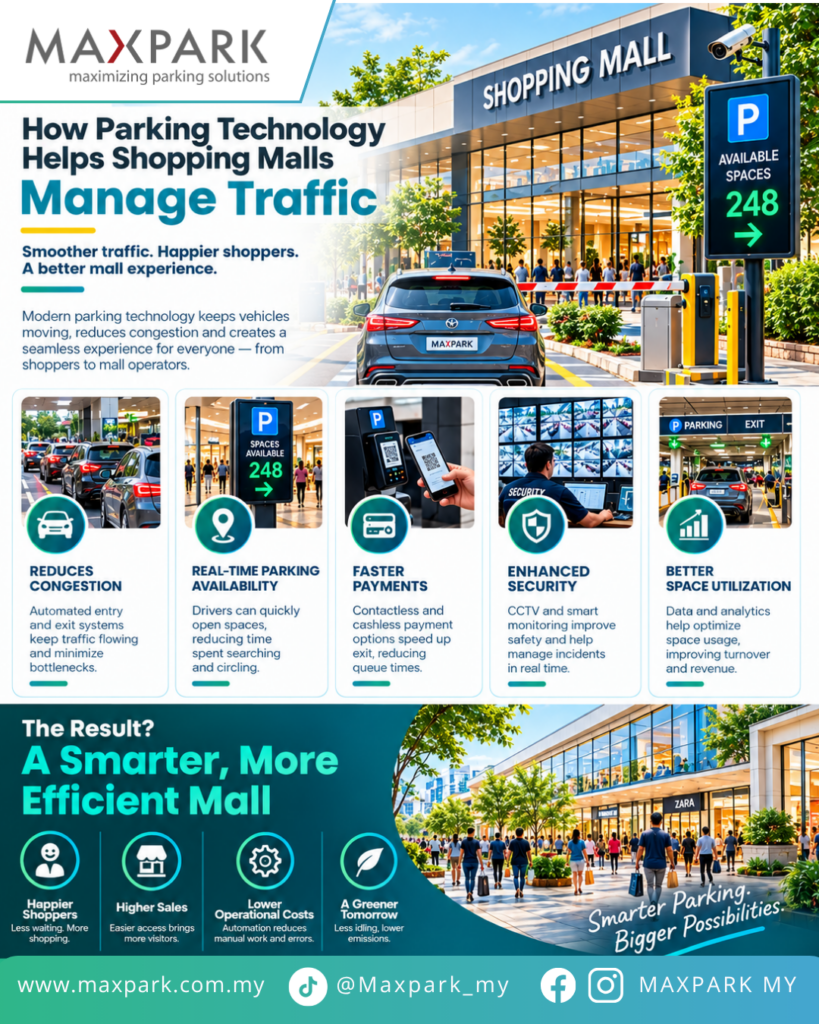
Modern parking technology provides a smarter solution. By combining automated entry and exit systems, real-time parking availability, digital guidance, cashless payments, security systems, and data analytics, shopping malls can create a more organized and efficient parking environment.
Reducing Parking Congestion
One of the biggest challenges in a busy shopping mall is vehicle congestion.
Traditional parking systems often require drivers to search manually for available spaces. When many vehicles are doing the same thing, traffic can build up throughout the car park.
Automated entry and exit systems can help keep vehicles moving more efficiently. When combined with parking guidance technology, drivers can be directed toward areas where spaces are available instead of continuously circling crowded sections.
Less unnecessary driving inside the car park means smoother traffic flow and a better experience for visitors.
Real-Time Parking Availability
Knowing where parking spaces are available can make a significant difference.
Smart parking systems use sensors, cameras, or other detection technologies to monitor parking occupancy. The information can then be displayed through digital signboards, LED indicators, or other guidance systems.
For example, a driver entering a mall could immediately see which floors or zones have available spaces. Instead of searching throughout the entire facility, they can follow clear directions toward an available area.
This reduces the time spent searching and helps distribute vehicles more efficiently throughout the parking facility.
Faster and More Convenient Payments
Payment queues can also contribute to congestion, particularly during busy periods.
Modern parking systems can support contactless and cashless payment options, allowing drivers to complete payments more quickly and continue toward the exit.
Faster payment processing can reduce queues at payment points and exit lanes. This is particularly useful for shopping malls where large numbers of vehicles may leave at approximately the same time after peak shopping periods.
A smoother payment process means less waiting for drivers and more efficient vehicle movement for the facility.
Enhanced Parking Security
Parking technology can also improve security within shopping mall car parks.
CCTV systems, smart monitoring, vehicle identification technologies, and centralized management platforms can give operators greater visibility across the facility.
Instead of relying entirely on manual observation, operators can monitor different areas and respond to incidents more efficiently.
Technologies such as Automatic Number Plate Recognition (ANPR) can also help identify and track vehicles entering and leaving a facility, depending on the system and its configuration.
Better monitoring can create a more secure environment for both vehicles and visitors.
Better Utilization of Parking Spaces
A parking facility can have plenty of capacity but still feel overcrowded if spaces are not being utilized efficiently.
Parking data can help operators understand how different areas of the car park are being used. They can identify busy zones, underused sections, peak periods, and changing parking patterns.
This information allows operators to make better decisions about traffic flow, signage, parking allocation, and future improvements.
Instead of managing the facility based only on assumptions, operators can use actual data to understand parking demand.
Improving the Shopper Experience
Parking is an important part of the overall shopping experience.
A visitor’s experience begins before they enter the mall. If they spend a long time looking for parking or get stuck in a queue, frustration can start before they even reach the shops.
Smart parking technology helps remove some of these common pain points.
With easier navigation, faster payments, clearer availability information, and better-organized traffic flow, visitors can spend less time dealing with parking and more time enjoying their visit.
This creates a smoother experience from arrival to departure.
Helping Shopping Malls Increase Efficiency
For mall operators, the benefits go beyond convenience.
A well-managed parking system can provide better control over the entire parking operation. Real-time information and analytics can help operators identify problems, monitor performance, and make informed operational decisions.
Improved parking efficiency can also help maximize the value of existing parking infrastructure. Rather than immediately looking at physical expansion, operators can first examine how technology can help them make better use of the spaces they already have.
Supporting Revenue and Business Performance
Parking management can indirectly influence the performance of a shopping mall.
When visitors can enter, park, shop, pay, and leave with fewer delays, the overall experience becomes more convenient. Easy access can encourage visitors to return and spend more time at the mall.
Better space utilization can also improve parking turnover, allowing the facility to accommodate more vehicles throughout the day.
For shopping malls, efficient parking is therefore not simply an operational concern. It can become an important part of the customer experience and business strategy.
A Greener Approach to Parking
Smart parking can also support more sustainable parking operations.
When drivers spend less time circling the car park looking for spaces, unnecessary vehicle movement can be reduced. This can help reduce fuel consumption and emissions associated with parking searches.
Better traffic management can therefore contribute to a more efficient and environmentally conscious shopping environment.
The Future of Shopping Mall Parking
As parking technology continues to develop, shopping mall car parks are becoming increasingly connected and data-driven.
Future systems can combine parking guidance, ANPR, cashless payments, CCTV, occupancy monitoring, mobile applications, and analytics into a single ecosystem.
Artificial intelligence and advanced analytics can further help operators understand parking patterns and anticipate demand.
The goal is to move from simply managing parking spaces to creating an intelligent parking environment that actively helps drivers and operators.
Conclusion
Shopping mall traffic management is becoming increasingly important as visitor numbers and vehicle volumes continue to grow. Traditional parking methods alone may not be enough to provide the smooth and convenient experience modern visitors expect.
Parking technology offers a smarter approach.
From reducing congestion and providing real-time parking availability to enabling faster payments, improving security, and optimizing space utilization, modern parking solutions can transform the way shopping malls manage their car parks.
For shoppers, this means less waiting, easier parking, and a more enjoyable mall experience. For operators, it means better efficiency, greater visibility, and smarter decision-making.
Ultimately, smarter parking creates more than organized car parks. It helps create smarter, more efficient, and more visitor-friendly shopping malls.
Get an appointment
MAXPARK PARKING SOLUTIONS

Products
Solutions
Solutions
- Cashless Parking System - Touch 'N Go & PayWave
- Parking Guidance System (PGS)
- Vehicle Counting System (VCS)
- Discount Validator System