
How Smart Parking Improves the Customer Experience
Introduction
Anyone who has circled a crowded parking building looking for an empty bay knows how quickly a simple errand can turn frustrating. A few minutes of searching for parking can set the tone for an entire visit to a mall, hospital, office tower, or airport — long before a customer even reaches their actual destination. In Malaysia’s increasingly congested urban centres, this small but common frustration has a real impact on how customers feel about the places they visit.
This is the problem smart parking technology was designed to solve. By combining sensors, mobile apps, digital signage, and automated payment systems, smart parking transforms what used to be a stressful guessing game into a smooth, predictable part of the customer journey. For property owners and operators, it is no longer just a convenience feature — it has become an expectation, particularly among tech-savvy consumers who are used to real-time information for almost everything else in their lives.
This article looks at what smart parking is, how it works, the problems it solves, and what businesses should consider when evaluating a system — with a look at how MAXPARK’s solutions fit into this picture.
What Is Smart Parking?
Smart parking refers to the use of technology to make finding, accessing, and paying for a parking space easier and more efficient. Instead of relying purely on physical signage, security guards, or trial-and-error driving through levels, a smart parking system uses digital tools to guide drivers directly to available spaces and manage the entire parking process electronically.
At its core, smart parking usually includes some combination of:
- Sensors or cameras that detect whether a parking bay is occupied or vacant
- Digital displays showing real-time availability at entrances, on each level, or above individual bays
- Mobile apps that let drivers check availability, reserve a spot, or pay before they arrive
- Automated entry and exit systems, such as license plate recognition or QR-code access
- Cashless payment options, reducing the need for tickets, coins, or manual cashiers
Together, these components remove much of the uncertainty and manual effort traditionally associated with parking.
How Smart Parking Systems Work
A typical smart parking setup begins with data collection. Sensors installed in individual bays, or cameras covering entire rows, continuously monitor occupancy status. This information is sent to a central system, which updates in real time.
From there, the data is made useful to drivers in a few ways:
- Guidance signage at entrances and along driving lanes shows how many spaces are available on each level or zone, often with directional arrows.
- Mobile apps allow drivers to see availability before they even arrive, and in some systems, reserve a specific bay.
- Entry and exit automation — using license plate recognition, QR codes, or mobile-based access — speeds up the process of entering and leaving the facility.
- Digital or cashless payment removes the need to queue at a manned booth or search for coins, allowing drivers to pay through an app, card, or e-wallet.
The result is a parking experience that requires far less manual searching and far less friction at every stage, from arrival to payment to exit.
Why Smart Parking Has Become Necessary
Traditional parking management was designed for a time when buildings had fewer vehicles and lower customer expectations. As shopping centres, hospitals, offices, and residential developments have grown denser, several problems have become harder to ignore:
Common Challenges with Traditional Parking
- Time wasted searching for spaces. Drivers often circle multiple levels before finding an open bay, especially during peak hours.
- Traffic congestion inside the facility. Vehicles moving slowly while searching for parking can create bottlenecks that affect everyone, not just the driver looking for a spot.
- Manual payment bottlenecks. Ticket machines and cashier booths can create queues, particularly during checkout periods when many vehicles leave at once.
- Limited visibility for operators. Without real-time data, building management has little insight into how the facility is actually being used, making it difficult to plan for peak periods or additional capacity.
- Inconsistent customer experience. Frustration with parking can carry over into how customers feel about the overall visit, even if the actual destination — a mall, clinic, or office — delivered good service.
These challenges are not just about convenience. They affect operational efficiency, energy use, and ultimately, how customers perceive a property or business.
Key Features and Benefits of Smart Parking
While every provider’s system may differ slightly, the value of smart parking generally centres around a few consistent benefits.
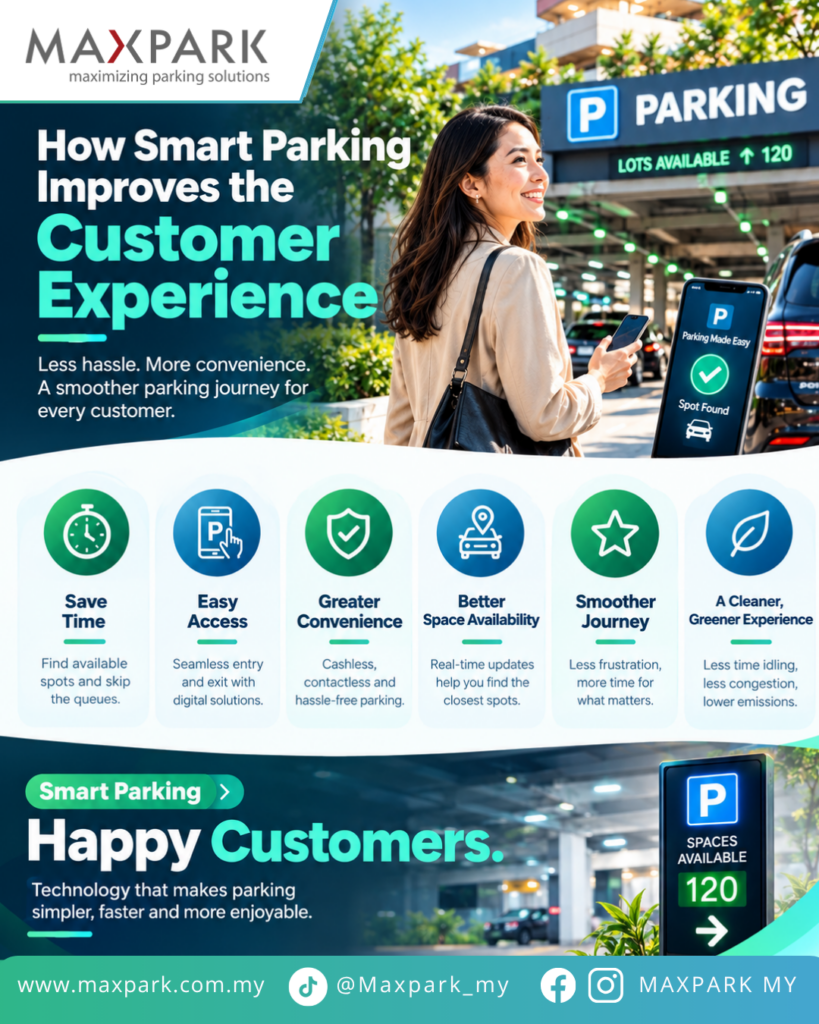
Save Time
Real-time availability information means drivers no longer need to guess where to go. Instead of circling multiple levels, they can head directly to a zone with open bays, cutting down search time significantly.
Easy Access
Digital entry and exit methods — such as QR codes, mobile apps, or license plate recognition — reduce the need to stop for physical tickets or manual checks, making entry and exit smoother.
Greater Convenience
Cashless and contactless payment options remove the hassle of carrying coins or waiting at a cashier booth, allowing customers to pay in a way that fits naturally into how they already manage daily transactions.
Better Space Availability Insights
Real-time updates on occupancy help drivers make informed decisions quickly, rather than relying on outdated or static signage.
A Smoother Overall Journey
When the parking process requires less effort and less waiting, customers arrive at their destination in a better frame of mind — which matters for retail, healthcare, hospitality, and workplace environments alike.
A Cleaner, Greener Experience
Less time spent idling and circling for parking means fewer vehicle emissions and reduced congestion within the facility, supporting broader sustainability goals that many Malaysian businesses and developments are now prioritising.
Considerations Before Choosing a Smart Parking Solution
Not every property has the same needs, so it is worth thinking through a few factors before adopting a smart parking system.
- Size and layout of the facility. A small surface car park has different requirements compared to a multi-level building with several access points.
- Existing infrastructure. Some systems can be integrated with existing barriers, cameras, or payment terminals, while others may require more extensive setup.
- User base. Consider how comfortable your typical customers are with mobile apps or digital payment methods, and whether alternative options are still needed.
- Choose a system that can grow with the property, particularly if further phases of development or additional parking levels are planned.
- Maintenance and support. Sensors, cameras, and software require ongoing upkeep, so reliable technical support is an important consideration.
- Data and reporting needs. If usage analytics are important for business planning, ensure the system provides clear, accessible reporting.
Taking time to assess these factors helps ensure that the chosen system genuinely fits the property’s needs, rather than adding complexity without meaningful benefit.
Implementation and Usage in Real-World Settings
Smart parking systems are commonly seen in shopping malls, hospitals, office towers, airports, and mixed-use developments across Malaysia — anywhere a large volume of vehicles needs to be managed efficiently.
Implementation typically involves:
- Site assessment to understand traffic flow, entry and exit points, and existing infrastructure.
- Installation of sensors, cameras, or detection technology across parking bays or zones.
- Integration with signage and access systems, so that data flows smoothly from detection to display to entry/exit control.
- Testing and calibration to ensure accuracy of occupancy data and smooth system performance.
- Staff and customer communication, helping both facility staff and regular users understand how to make use of new features such as mobile apps or digital payment.
Ongoing operation involves regular monitoring, software updates, and maintenance of hardware components to keep the system functioning reliably over time.
Common Misconceptions About Smart Parking
A few misunderstandings are worth addressing:
- “Smart parking is only for large, high-tech cities.” In reality, any facility dealing with regular congestion or customer complaints about parking can benefit, regardless of city size.
- “It’s just about apps.” While mobile apps are a visible part of smart parking, the underlying value comes from the combination of sensors, real-time data, and streamlined access — not the app alone.
- “It replaces the need for staff.” Smart parking reduces manual bottlenecks, but staff often still play a role in customer service, security, and handling exceptions.
- “Once installed, no further attention is needed.” Like any technology system, smart parking requires ongoing maintenance and occasional updates to continue performing well.
The MAXPARK Connection
The challenges outlined above — long search times, congestion, payment bottlenecks, and limited operational visibility — are exactly the areas where a well-designed smart parking system makes a measurable difference.
MAXPARK works with property owners and operators to bring these capabilities into real-world facilities, helping bridge the gap between outdated manual parking processes and the smoother, more predictable experience customers now expect. This includes real-time space detection and guidance, digital and cashless payment options, and automated entry and exit systems designed to reduce friction at every stage of a customer’s parking journey.
Rather than treating parking as an afterthought, MAXPARK approaches it as part of the overall customer experience — recognising that how easily someone can park often shapes how they feel about the visit that follows, whether that’s a shopping trip, a hospital appointment, or a day at the office.
For businesses evaluating their parking infrastructure, MAXPARK’s role is to help identify the right combination of technology for the specific property, rather than applying a one-size-fits-all approach.
Practical Guidance for Businesses Evaluating Smart Parking
If you are considering upgrading your parking facility, here are some practical steps to guide the process:
- Start with an honest assessment of current pain points. Are customers complaining about long queues, difficulty finding spaces, or slow entry and exit? Identifying specific problems helps prioritise which features matter most.
- Walk through the customer journey. Consider the experience from the moment a vehicle approaches the facility to the moment it leaves, and look for points of friction along the way.
- Involve facility and security staff early. They often have first-hand insight into recurring issues that customers may not directly report.
- Ask about integration, not just features. A good system should work well with your existing building infrastructure, not create a separate, disconnected process.
- Plan for change management. Even the best system needs a clear rollout plan so that both staff and regular customers understand how to use new features.
Review performance after implementation. Use available data and customer feedback to identify whether the system is genuinely reducing congestion and improving satisfaction, and adjust where
Conclusion
Parking may seem like a small part of the customer journey, but it often sets the tone for how someone feels about an entire visit. Long searches for a space, congested driving lanes, and slow payment processes create friction that traditional parking management struggles to solve on its own.
Smart parking addresses these issues directly — through real-time space detection, digital guidance, cashless payment, and automated access — turning what used to be a source of frustration into a smooth, almost invisible part of the experience. For businesses, this translates into happier customers, more efficient use of space, and better operational insight.
Choosing the right smart parking solution requires careful thought about a property’s specific needs, existing infrastructure, and customer base. This is where working with an experienced provider makes a real difference. MAXPARK’s approach focuses on understanding these practical realities and applying the right combination of technology to create a parking experience that supports, rather than detracts from, the overall customer journey — helping turn smart parking into genuinely happy customers.
Get an appointment
MAXPARK PARKING SOLUTIONS

Products
Solutions
Solutions
- Cashless Parking System - Touch 'N Go & PayWave
- Parking Guidance System (PGS)
- Vehicle Counting System (VCS)
- Discount Validator System