
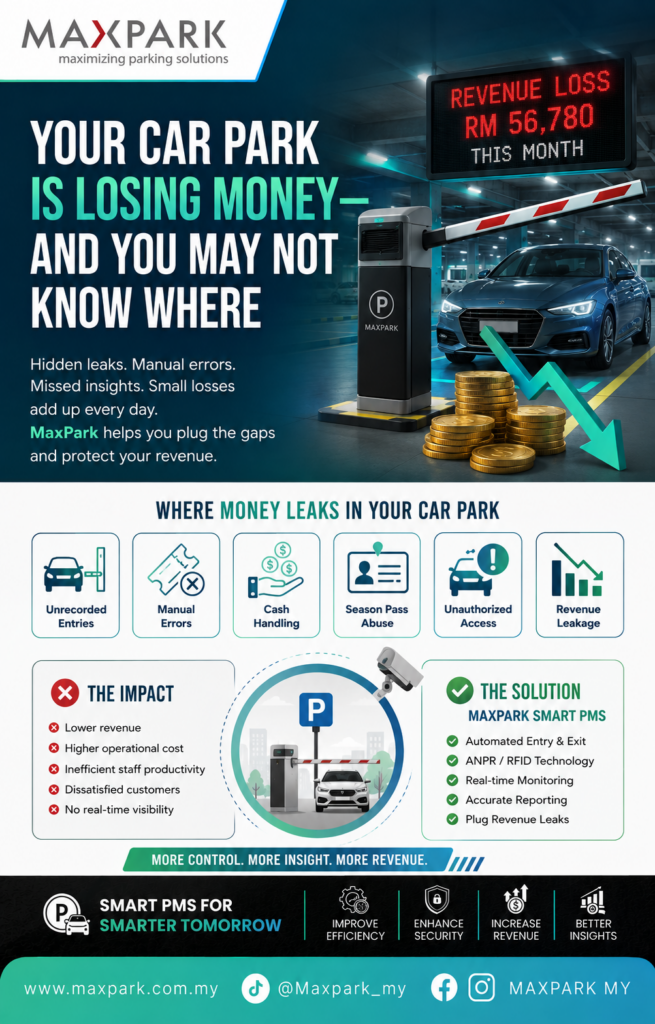
Your Car Park Is Losing Money — And You May Not Know Where
Introduction
A car park can be one of the most valuable assets of a commercial property, yet it is also an area where revenue can quietly disappear.
Every day, vehicles enter and exit, parking fees are collected, season passes are used, staff manage operations, and customers move through the facility. When these processes are handled manually or without proper monitoring, small gaps can develop.
An unrecorded entry here. A payment error there. An abused season pass. An unauthorised vehicle. Poor cash handling. Missing operational data.
Individually, these issues may appear insignificant. But over time, they can add up to substantial revenue leakage.
In fact, smart parking initiatives are increasingly being used to improve compliance and strengthen parking revenue collection. In Selangor, for example, the state government has described its intelligent parking initiative as a way to address uncollected parking revenue through technology.
The real question for parking operators is not simply “How much revenue are we collecting?”
It is:
“How much revenue are we potentially losing without knowing it?”
Where Does Parking Revenue Leak?
Revenue leakage does not always happen because someone deliberately takes money. It can also occur because of inefficient processes, incomplete records, system limitations, human error, or a lack of real-time visibility.
Here are some of the most common areas where revenue can be lost.
1. Unrecorded Entries
Every vehicle entering a paid car park represents a potential transaction.
If entries are not accurately recorded, operators may have difficulty determining how many vehicles entered, how long they stayed, and whether the correct parking fee was eventually collected.
Manual ticketing and manual record-keeping can make this more difficult, particularly in busy facilities.
Automated systems can help create a digital record of vehicle movements and provide operators with better visibility over entry and exit activity.
2. Manual Errors
Human involvement is important in parking operations, but repetitive manual processes can create opportunities for mistakes.
Incorrect ticket information, payment discrepancies, data-entry mistakes, lost tickets, or incorrect transaction records can affect revenue accuracy.
The more manual processes a facility relies on, the more important it becomes to have proper controls and reconciliation.
Automation can reduce repetitive tasks and create more consistent records across the parking operation.
3. Cash Handling
Cash-based parking operations can create additional administrative challenges.
When payments are handled manually, operators need to manage collection, reconciliation, cash storage, reporting, and auditing.
Digital and cashless payment systems can reduce the amount of physical cash moving through a parking facility while creating electronic transaction records.
Modern parking systems can integrate cashless payment methods with automated entry and exit processes, helping operators create a more transparent transaction flow.
The objective is not simply to make payment more convenient for drivers.
It is also to make revenue easier to track.
4. Season Pass Abuse
Season passes can provide convenience for regular users, but without proper controls, they can also become difficult to monitor.
A pass may be shared, used by an unauthorised vehicle, or remain active beyond its intended usage.
Smart parking technology can link access permissions to vehicle information, such as a registered number plate, allowing operators to better control who is authorised to enter.
ANPR/LPR technology can automatically recognise vehicle number plates and create records of vehicle movements, making it easier to monitor access.
This creates a stronger connection between the vehicle, the parking access, and the authorised user.
5. Unauthorised Access
Not every vehicle entering a car park should necessarily have unrestricted access.
Unauthorised access can create security problems while potentially affecting parking revenue.
For example, a vehicle may enter using an invalid credential, access a restricted area, or occupy parking intended for authorised users.
Combining automated barriers, access control, ANPR, and CCTV can give operators greater visibility over who is entering and leaving the facility.
This is where parking management becomes more than a payment system.
It becomes an access and security system.
6. Lack of Real-Time Visibility
Perhaps one of the biggest problems is not knowing what is happening inside your car park right now.
If management only receives reports at the end of the day or month, it may be difficult to identify problems while they are happening.
How many vehicles entered today?
How many transactions were completed?
Are there unusual access patterns?
Are certain lanes experiencing problems?
Are parking spaces being used efficiently?
Is revenue matching vehicle activity?
Without real-time information, answering these questions can be difficult.
A smart parking management system can bring operational information together through dashboards and reports, allowing managers to monitor activity more effectively.
The True Cost of Revenue Leakage
Revenue leakage does not only affect the amount of money collected.
It can also create wider operational consequences.
Lower Revenue
The most obvious impact is reduced parking income.
Even relatively small losses occurring repeatedly can become significant over time.
Higher Operational Costs
Manual processes require staff time.
The more processes that need to be handled manually, the more resources may be required to operate the car park.
Inefficient Staff Productivity
Employees may spend valuable time dealing with repetitive tasks, payment discrepancies, access issues, manual reporting, and customer complaints.
Automation can allow staff to focus on tasks that require human attention instead.
Dissatisfied Customers
Long queues, slow entry and exit, payment problems, and unclear parking procedures can negatively affect the customer experience.
A smoother parking process can contribute to a better overall experience at the property.
Limited Business Visibility
Without accurate data, property managers may find it difficult to understand parking demand, occupancy, traffic patterns, revenue performance, and operational problems.
This can make strategic decision-making harder.
How Smart Parking Helps Plug the Gaps
The solution is not simply to collect more money.
The solution is to create a parking operation where every vehicle movement, transaction, and access event can be monitored and managed more effectively.
A smart Parking Management System (PMS) can bring multiple technologies together to achieve this.
Automated Entry & Exit
Automated entry and exit systems can reduce reliance on manual processes at parking barriers.
When integrated with vehicle recognition and access control, the system can record vehicle movements and help create a more consistent entry and exit process.
This can also reduce queues and improve traffic flow.
ANPR / RFID Technology
Automatic Number Plate Recognition (ANPR) allows cameras to identify vehicle number plates and associate them with parking activity.
RFID technology can also be used for vehicle identification and access management where appropriate.
Together with the right parking software, these technologies can help operators create more accurate records of vehicle movements and authorised access.
ANPR is already being used at scale within parking management, with one major parking operator reporting more than 1,400 ANPR sites under management as of June 2024.
Real-Time Monitoring
A smart parking system can provide operators with a centralised view of parking activity.
Instead of waiting for manual reports, management can monitor information as it becomes available.
This can help identify:
- Unusual activity
- Access problems
- Payment issues
- Equipment problems
- Occupancy trends
- Operational performance
The faster a problem is identified, the faster it can potentially be addressed.
Accurate Reporting
Data is one of the most valuable assets in modern parking management.
A good reporting system can help property owners understand what is happening across their car park.
Reports can provide insights into:
- Daily vehicle entries
- Exit activity
- Parking duration
- Payment transactions
- Occupancy patterns
- Peak periods
- Revenue performance
- Access activity
This transforms parking management from guesswork into data-driven decision-making.
More Control. More Insight. More Revenue.
A smart parking system should ultimately give property owners greater control over their parking assets.
Instead of asking:
“Where is our revenue going?”
management can begin asking:
“What does our parking data tell us?”
That change in perspective is important.
When vehicle activity, access control, payment systems, and reporting are connected, operators can identify potential gaps and take action based on actual information.
The objective is not simply to increase parking fees.
It is to ensure that the revenue already being generated by the facility is properly captured, recorded, and managed.
Smart PMS for a Smarter Tomorrow
The future of parking management is moving toward greater automation, connectivity, and data visibility.
Property owners are increasingly looking for ways to improve efficiency while reducing unnecessary manual processes.
Smart parking can support this transformation through:
Improved Efficiency
Automate repetitive processes and streamline vehicle movement.
Enhanced Security
Control access and maintain better visibility over vehicle activity.
Increased Revenue Protection
Reduce potential leakage caused by manual errors, unauthorised access, and weak transaction controls.
Better Insights
Use real-time information and reporting to make better operational decisions.
These benefits work together to create a stronger parking ecosystem.
Why Revenue Protection Should Be a Priority
For many businesses, parking is treated as an operational necessity rather than a revenue-generating asset.
But a well-managed car park can contribute significantly to a property’s overall performance.
In Malaysia, parking revenue can represent substantial amounts for local authorities and property operators. Official Selangor figures, for example, show that several local authorities collected millions of ringgit in parking revenue annually before the rollout of its intelligent parking system.
When the numbers become this significant, even small inefficiencies deserve attention.
A 24/7 parking facility does not stop operating when management leaves for the day.
That is why automated monitoring and accurate digital records are so important.
The Bottom Line
Revenue leakage rarely comes from one single problem.
It can come from a combination of:
- Unrecorded entries
- Manual errors
- Cash handling
- Season pass abuse
- Unauthorised access
- Limited monitoring
- Inaccurate reporting
- Inefficient processes
The challenge is that many of these losses can remain invisible until they accumulate.
Smart parking management provides a way to bring these processes together and create greater visibility across the entire parking operation.
With technologies such as automated entry and exit, ANPR/RFID, real-time monitoring, and accurate reporting, property owners can gain greater control over their parking facilities and identify potential revenue gaps more effectively.
Conclusion
Your car park may be generating revenue every day—but if you cannot clearly see every entry, exit, transaction, and access event, you may not be capturing its full potential.
The future of parking is not just about making vehicles enter and exit faster.
It is about creating a parking operation that is automated, secure, measurable, and accountable.
Every vehicle should be accounted for.
Every transaction should be traceable.
Every access point should be monitored.
And every potential revenue leak should have a way to be identified.
More control. More insight. More revenue.
With Maxpark Smart PMS, smarter parking management can help businesses move from simply managing a car park to managing it with greater intelligence, visibility, and control.
Get an appointment
MAXPARK PARKING SOLUTIONS

Products
Solutions
Solutions
- Cashless Parking System - Touch 'N Go & PayWave
- Parking Guidance System (PGS)
- Vehicle Counting System (VCS)
- Discount Validator System