
5 Big Benefits of Smart Parking Systems
Introduction
If you manage a commercial car park, you already know the truth: parking operations are only as strong as the data behind them. In 2026, many sites still rely on manual vehicle logging—guards writing down plate numbers, staff typing entries into spreadsheets, and operators trying to reconcile records after the fact.
It works—until it doesn’t.
Manual logging creates delays, introduces errors, and leaves gaps that cost you time, money, and control. That’s why more commercial spaces are shifting to Automated License Plate Recognition (LPR) as a core part of a modern smart parking system.
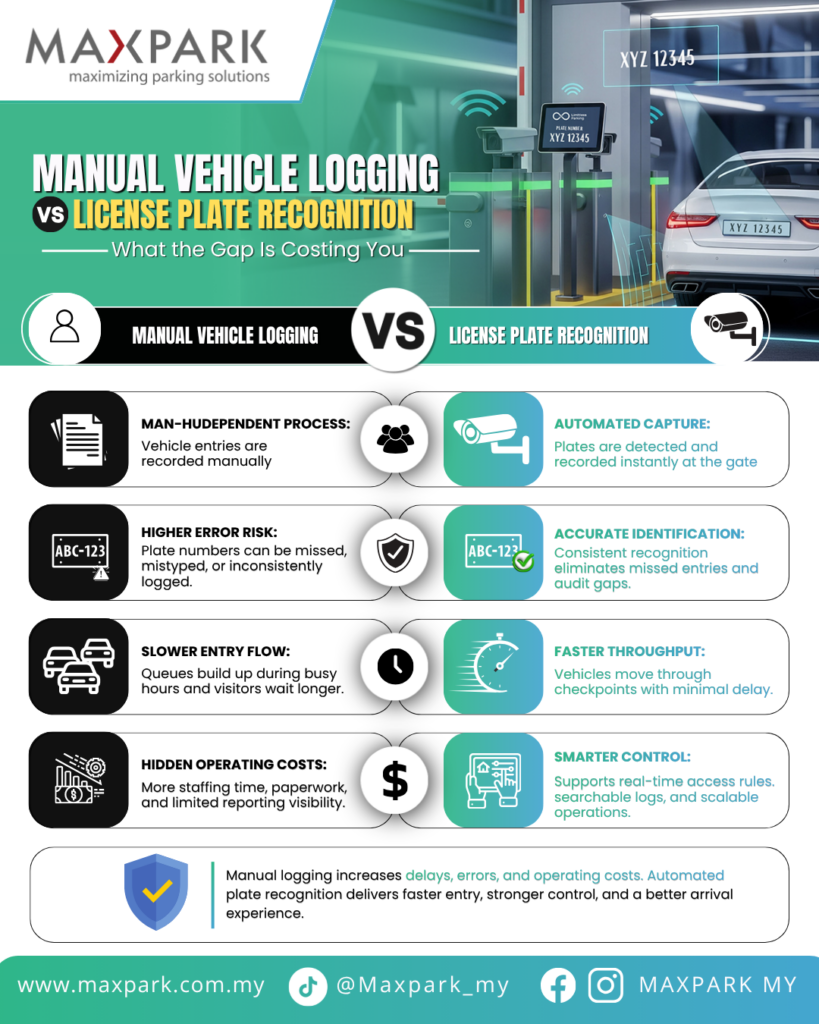
This article breaks down the real operational difference between manual logging and automated plate recognition—and what the gap is costing your property.
1) Human-dependent process vs automated capture
Manual vehicle logging: depends on people, every time Manual logging requires guards or staff to record vehicle entries and exits. Even with a well-trained team, the process is vulnerable to:
- Fatigue during peak hours
- Distractions and multitasking
- Inconsistent formatting (different ways of writing the same plate)
- Missed entries when traffic is heavy
Automated LPR: instant capture at the gateWith automated plate recognition, plates are detected and recorded instantly at entry/exit points. This creates:
- Consistent records
- Faster processing
- Less reliance on manual effort
For operators, the key shift is simple: instead of hoping the data is correct, you can trust that the system captures it as it happens.
2) Higher error risk vs accurate identification
Manual logging: small errors become big problems A single mistyped character can create a chain of issues—wrong vehicle records, disputes, and incomplete audit trails. Common problems include:
- Plates being missed entirely
- Confusing similar characters (e.g., 0/O, 1/I)
- Inconsistent logging standards across shifts
These errors don’t just affect reporting—they affect enforcement, security, and customer trust.
Automated LPR: consistent recognition reduces audit gapsAutomated recognition improves accuracy and consistency, helping you:
- Reduce missed entries
- Improve traceability for incidents
- Maintain cleaner logs for audits and investigations
In short: fewer gaps, fewer disputes, and fewer hours spent trying to reconcile what happened.
3) Slower entry flow vs faster throughput
Manual logging: queues build up during busy hoursWhen staff must stop and record details, throughput drops. That creates:
- Longer queues at entry points
- Frustrated visitors and tenants
- Increased congestion that spills into surrounding roads
In retail and mixed-use environments, slow entry can directly impact footfall and customer experience.
Automated LPR: vehicles move through with minimal delayAutomated capture keeps vehicles moving through checkpoints faster. The result:
- Smoother traffic flow
- Reduced bottlenecks
- Better first impressions for visitors
Even small reductions in wait time can significantly improve satisfaction during peak periods.
4) Hidden operating costs vs smarter control
Manual logging: costs hide in staffing and admin workManual processes often look cheaper on paper—until you account for the real operating costs:
- More staffing time needed at gates
- Paperwork and manual data entry
- Time spent resolving disputes
- Limited reporting visibility for management
And because reporting is often incomplete, it’s harder to optimize operations or justify improvements.
Automated LPR: real-time rules, searchable logs, scalable operationsWith automated plate recognition, you gain smarter operational control, including:
- Real-time access rules (who can enter, when, and where)
- Searchable logs for quick verification
- Better visibility for reporting and decision-making
- Easier scaling across lanes, zones, or multiple sites
This is where parking operations shift from reactive to proactive.
5) Why this matters in 2026: expectations are higher
In 2026, commercial spaces are expected to run like modern systems—not manual checklists. Tenants want smoother access. Visitors expect minimal friction. Operators need stronger security and better data.
If your parking operation still relies on manual logging, you’re not just dealing with inconvenience—you’re accepting:
- Higher error rates
- Slower throughput
- More staffing burden
- Weaker auditability
- Less operational visibility
6) How MaxPark helps modernize parking operations
MaxPark supports commercial properties that want to move beyond manual processes into smarter, automated parking management.
By implementing modern parking technology (including LPR/ANPR), MaxPark helps operators work toward:
- Faster entry and exit experiences
- Stronger security and traceable records
- Better operational insights for decision-making
- Scalable systems that grow with your property
Conclusion
Manual vehicle logging may feel familiar, but the operational gap is real—and it costs you in delays, errors, and hidden operating costs.
Automated License Plate Recognition (LPR) delivers a better alternative: faster throughput, stronger control, and cleaner data you can actually rely on.
If you’re ready to reduce friction at your gates and improve parking performance in 2026, MaxPark can help you take the next step
Get an appointment
MAXPARK PARKING SOLUTIONS
MaxPark is a recognized leader in the field of parking management solutions in Asia Pacific for more than 30 years and ISO 9001 certified.

MaxPark, a recognized leader in parking management solutions in the Asia Pacific for over 30 years, is proud to be ISO 9001 certified. Additionally, we are certified TNG system integrators, ensuring top-quality service and expertise in our industry-leading solutions.
Products
Solutions
Solutions
- Cashless Parking System - Touch 'N Go & PayWave
- Parking Guidance System (PGS)
- Vehicle Counting System (VCS)
- Discount Validator System
Copyright © 2023 MaxPark, All rights reserved.